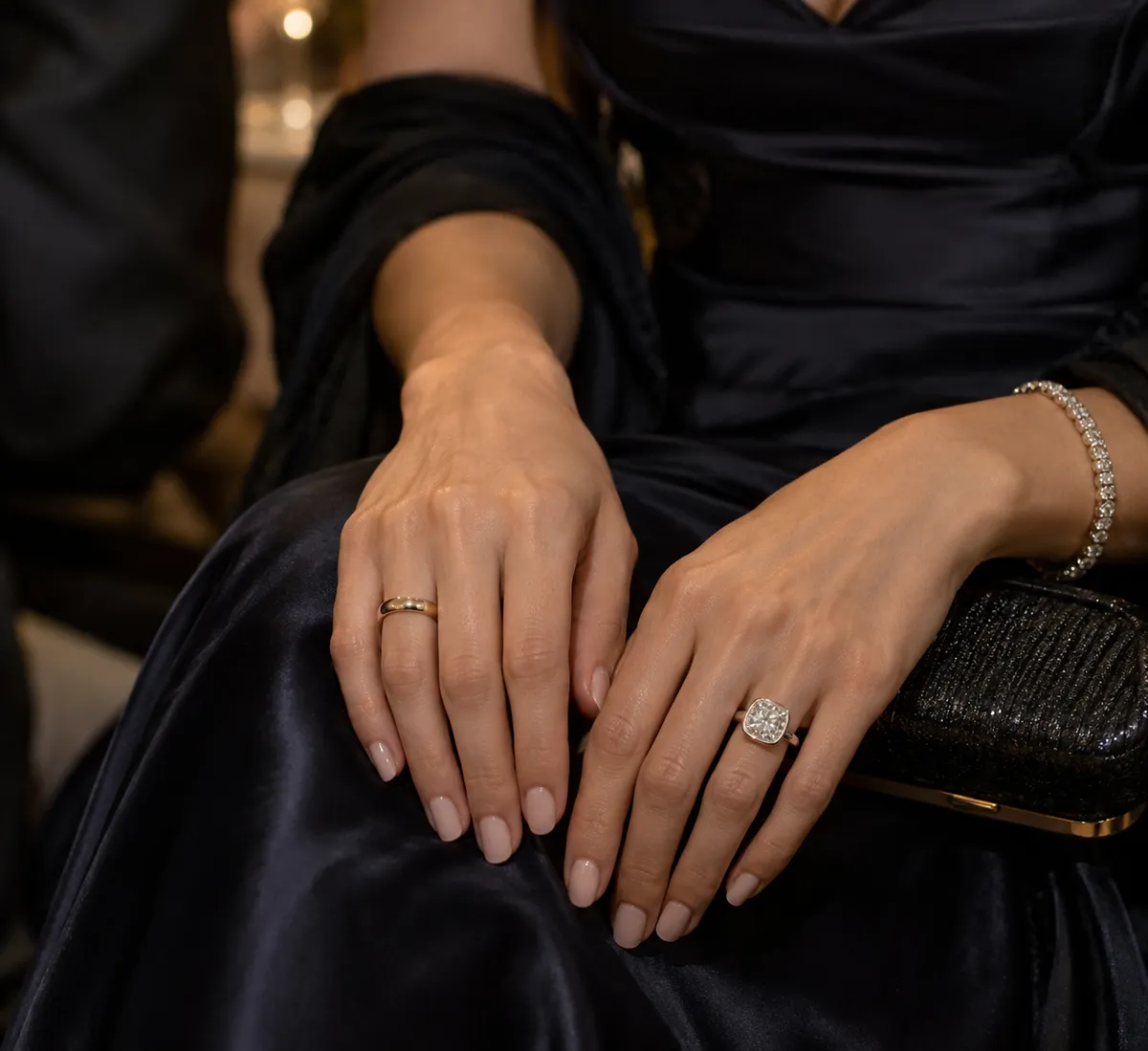
Taylor Swift walked into the Academy Museum Gala with her ring finger doing something new. Per Elle, she wore her wedding band on her left hand and moved her old mine cushion-cut engagement ring over to her right. It's the clearest public look yet at the band worn on its own, and for a couple whose wedding details remain under a microscope, that's catnip for fans.
The story: One Band, Two Hands
Here's what Elle reports. The wedding band now sits solo on Swift's left hand. The engagement ring has relocated to her right. Jewelers consulted by the outlet broke down the band's design, its proportions, its bezel setting, and how it pairs with the engagement ring's old mine cushion cut.
That's the sourced part. What follows is my read.
Why a Split Stack Is a Big Deal for a Celebrity Ring
Most celebrity ring coverage is a still life: one hand, one ring, one zoomed-in photo. Swift changing the arrangement turns it into a plot point. It's hard not to wonder whether this was a style decision, a practical one, or both. Elle's coverage touches on the practical side, and one angle in the discussion around the look is whether she separated the rings for a guitar performance. That is a possibility, not a confirmed reason, and nothing in Elle's reporting says Swift has explained it herself.
Still, the logic is easy to appreciate for anyone who has seen an artist at work. A chunky stone and a guitar neck are not natural friends. A low-profile band is a lot more forgiving. If that's even part of the thinking, it would fit the rising interest in practical, mix-and-match bridal jewelry styling that makes this moment resonate beyond fan accounts.
The Band Itself: Bezel Is the Word
The jewelers Elle spoke with focused on the bezel setting, where the stones are encircled by metal rather than perched on prongs. As a style observation (mine, not theirs), bezel settings are the sensible-shoes of the ring world: sleek, snag-resistant, and quietly confident. They also make sense for a band meant to be worn day in, day out.
Elle's breakdown also addresses proportions and how the band complements the engagement ring. That matters because her engagement ring has a very particular personality. An old mine cushion cut has a soft, vintage glow, and a band that tries to out-sparkle it would be a rude guest. A bezel-set band reads as a polished counterpart rather than a competitor.
The Takeaway for Your Own Ring Shelf
You don't need a Swiftie-sized budget to borrow the idea. Based on the details Elle highlights, a few styling lessons stand out:
- Pick a band that can stand alone. Swift's is now being seen solo, which is a pretty good stress test. If it looks finished without its partner, it will work stacked or separate.
- Don't crowd the star stone. Proportion is one of the things the jewelers examined. A band should support the engagement ring, not fight it.
- Consider the bezel. It's a practical, streamlined setting that suits active hands.
- Let the rings move. Wearing the engagement ring on the right hand is a simple option when the occasion calls for it.
Practical Luxury, Pop Star Edition
There's something quietly funny about the most scrutinized ring finger in pop culture delivering its biggest news without a single announcement. No caption, no statement, just a different hand and a very observant internet. That's the Swift playbook in miniature: leave a detail where fans can find it, then let the theories do the rest.
As for the Academy Museum Gala, it was a fitting stage for a subtle plot twist. Film nerds go there to admire preserved artifacts. This time, the most talked-about piece of design was a band on a left hand, doing its job without making a speech.
Whether the switch was about a guitar, a look, or simply a Tuesday-night preference, the lesson holds: the best jewelry flex is one that works hard and still looks effortless.